
Animation is a powerful visual medium that communicates the appeal of a service or brand intuitively and effectively, and it is widely used by companies across industries.
However, producing animation in-house requires specialized talent, tools, and production infrastructure, making it a high barrier for many organizations. As a result, outsourcing anime production has become an increasingly attractive option.
This article focuses on the advantages of outsourcing anime production, while also outlining the differences from in-house production, key considerations, and cost benchmarks—providing a framework for determining the most suitable production approach for your company.
Advantages of Outsourcing Anime Production
The greatest advantage of outsourcing anime production lies in the ability to achieve a level of quality and expressive power that is difficult to realize internally.
By minimizing the burden of hiring talent and building production systems, companies can efficiently create animations that align with their objectives. Below are the key benefits of outsourcing anime production.
Achieving Professional-Grade Animation Quality
Animation studios employ specialists in direction, animation, editing, and production management.
This expertise enables them to produce animations that are easy to understand, emotionally engaging, and visually memorable.
Carefully calculated elements such as pacing, composition, and color design are the result of experience and proven workflows, contributing directly to stronger brand perception and credibility.
Reducing Internal Production Resources
In-house animation production requires significant investment in staffing, training, and software tools.
Outsourcing eliminates the need for these preparations, allowing companies to reduce both time and labor costs.
This enables internal teams to focus on core business activities, making outsourcing a highly efficient option for organizations with limited resources.
Delegating Scheduling and Production Management
Animation production involves many complex processes and can be difficult to manage internally.
By outsourcing, companies can rely on the production studio to manage schedules, workflows, and delivery timelines from planning through final delivery.
Professional project management reduces internal workload and helps ensure smooth, on-time production.
Access to a Wide Range of Techniques and Visual Styles
Animation studios are equipped to handle diverse techniques, including 2D animation, 3D animation, and motion graphics.
This makes it easier to incorporate advanced visual expressions or current trends that may be difficult to execute in-house.
Outsourcing allows companies to select the most suitable visual approach based on purpose and target audience.
Smooth Revision Handling and Quality Control
Revisions and adjustments are common in animation projects.
When outsourcing, studios typically have established workflows for revisions and quality control, ensuring consistency and maintaining production standards.
Clear communication rules help prevent misunderstandings and provide peace of mind throughout the production process.
Potential for Lower Overall Costs
Although outsourcing may initially appear expensive, when factoring in personnel costs, equipment investment, and training expenses, it can be more cost-effective than in-house production.
This is particularly true for one-off or short-term projects, where outsourcing often delivers a higher return on investment by leveraging specialized expertise only when needed.
Disadvantages of Outsourcing Anime Production
While outsourcing offers many benefits, there are also drawbacks that should be understood in advance.
A balanced evaluation of both advantages and risks is essential when considering outsourcing.
Outsourcing Costs Are Required
Outsourcing inevitably involves external production fees.
Costs vary widely depending on video length, complexity, and quality requirements, and may exceed initial expectations.
Compared to in-house production, where costs may be limited to internal labor, budget constraints can be more noticeable. Clear budget planning aligned with project goals is therefore critical.
Risk of Misalignment if Creative Vision Is Not Shared Clearly
Because production is handled by external creators, insufficient communication can result in a mismatch between expectations and final output.
This risk is particularly high when projects involve specific worldviews, tones, or detailed creative preferences. Clear articulation of objectives, references, and visual examples during early stages is essential.
Dependency on the Studio’s Schedule
Popular studios or peak production periods may limit scheduling flexibility.
Unlike in-house production, timelines cannot always be controlled solely by the client.
For projects with fixed deadlines, early consultation and buffer time are necessary to mitigate scheduling risks.
Which Companies Should Outsource Anime Production—and Which Should Not?
Outsourcing is not the optimal choice for every organization. The decision depends on internal capabilities, objectives, and production frequency.
Companies Well-Suited for Outsourcing
Companies without in-house animation specialists or with limited video production experience are strong candidates for outsourcing.
By leveraging professional expertise, they can achieve reliable quality within a short timeframe.
Outsourcing is also ideal for one-time promotional videos or campaign-specific animations.
For organizations operating with limited budgets or personnel, outsourcing offers an efficient and practical solution.
Additionally, companies seeking objective creative input or external perspectives on branding and expression often benefit from outsourcing.
Companies Better Suited for In-House Production
Organizations that produce animation on a continuous basis and already employ skilled designers or video specialists may benefit more from in-house production.
Over time, internal production allows for the accumulation of know-how and can reduce long-term costs.
It also enables faster iteration and more flexible revisions, which is valuable for content requiring frequent updates.
For companies that regularly communicate a proprietary visual identity or unique worldview, in-house production can be an effective strategy.
Typical Workflow for Outsourcing Anime Production
Outsourced anime production follows a structured, multi-step process. Understanding this flow helps ensure smoother collaboration and reduces the risk of mismatched expectations.
Step 1: Planning and Objective Alignment
The process begins with discussions around project goals, target audience, distribution channels, and usage scenarios.
Clarifying objectives at this stage sets a strong foundation for creative direction and structure.
Step 2: Structure Planning and Storyboard (E-conte) Creation
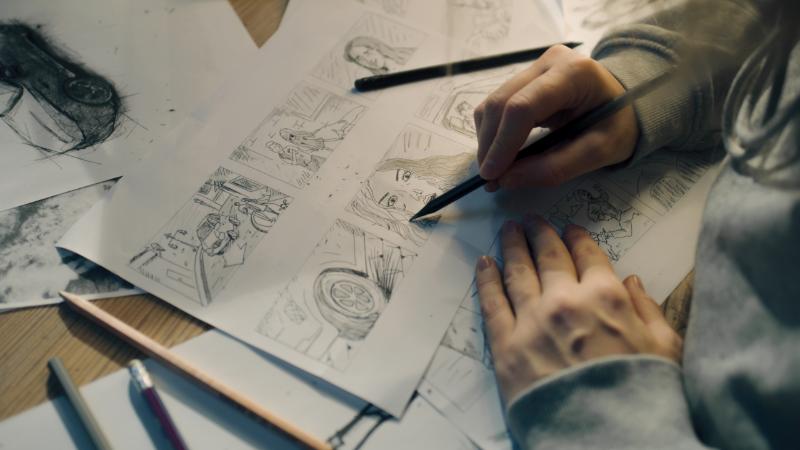
Based on the initial briefing, the studio develops a structure outline and storyboard (E-conte).
This visual blueprint allows stakeholders to review pacing, scene flow, and messaging before full production begins.
Early alignment here significantly reduces the risk of major revisions later.
Step 3: Design and Character Development
Once the structure is approved, character design (Character Design / Chara Design), backgrounds, and visual tone are developed.
Color palettes and overall atmosphere are refined to align with brand identity.
Revisions are incorporated as needed before finalizing designs.
Step 4: Animation Production
With designs finalized, animation production begins.
Motion, direction, music, and sound effects are added, transforming static assets into a complete animated sequence.
Attention is given to timing, movement, and emotional impact to ensure high quality.
Step 5: Editing and Final Delivery
In the final stage, overall editing and quality checks are conducted.
After revisions are addressed, the completed animation is delivered in the specified format and resolution, ready for immediate use.
Typical Cost Ranges for Outsourced Anime Production
Outsourcing costs vary significantly depending on animation type, length, and complexity.
As a general guideline, even short animations of 30 seconds to 1 minute often range from tens of thousands to several hundred thousand yen—or more.
For studio-produced animations, a 30-second to 1-minute video may cost approximately ¥100,000 to ¥300,000, and in some cases ¥300,000 to ¥2,000,000 or more.
Web-oriented short animations commonly range from ¥1,000,000 to ¥10,000,000.
High-end promotional or branding animations may cost several million to tens of millions of yen.
For complex 3DCG or long-form, high-production-value projects, budgets can exceed ¥10,000,000 and may reach hundreds of millions of yen.
Because costs scale with quality expectations, it is essential to compare estimates carefully based on purpose and usage.
Key Points When Choosing an Animation Outsourcing Partner

Selecting the right studio is critical to maximizing the benefits of outsourcing.
Choose a Studio That Can Propose Ideas, Not Just Execute
Studios that provide strategic input—from concept development to execution—add significant value.
Their ability to propose structures and expressions aligned with business goals leads to more effective outcomes.
Review Production Track Records and Portfolios
Examining past work helps determine whether a studio’s style and quality align with your needs.
Experience in similar industries or use cases is a strong indicator of suitability.
Prioritize Clear and Careful Communication
Successful animation production depends on precise alignment of creative vision.
Studios that conduct thorough hearings and actively clarify intent are more likely to deliver satisfactory results.
Confirm Revision Rules in Advance
Clarify revision limits, scope, and additional costs before production begins.
Clear rules help prevent misunderstandings and ensure smooth progress.
Ensure Robust Schedule Management
Reliable schedule management is essential, especially for projects with fixed release dates.
Studios that regularly share progress updates and maintain transparent timelines are better partners.
Why Outsource Anime Production to Creative Freaks
When outsourcing anime production, the most important factor is choosing a partner who understands not only how to create visuals, but why they are being created and how they contribute to business results.
Creative Freaks provides end-to-end support—from concept planning to final delivery—based on a deep understanding of each client’s goals and challenges.
In addition to high-quality visuals, Creative Freaks offers strategic proposals informed by marketing perspectives.
Whether for service promotion, recruitment, branding, or advertising, the studio designs animation expressions that resonate with target audiences.
By aligning expectations at the storyboard (E-conte) stage, Creative Freaks minimizes post-production discrepancies.
Clear rules for scheduling and revisions ensure a smooth experience, even for companies outsourcing animation for the first time or working with Japanese studios for the first time.
For companies seeking to communicate their value effectively through animation, outsourcing to Creative Freaks is a strong strategic choice.